Last verified: September 20, 2026
The pace of artificial intelligence development has made model nomenclature increasingly dense, occasionally leading to confusion across developer communities. A frequent question circulating among engineers, researchers, and technology leaders concerns a model often referred to online as “GPT-5.6 Astra.”
Before examining its technical architecture and capabilities, an important naming clarification is necessary: “GPT-5.6 Astra” is not an official OpenAI model name. Rather, it conflates two distinct product cycles released by OpenAI during 2026. The previous generation of flagship intelligence is the GPT-5.6 family (comprising Sol, Terra, and Luna, launched in July 2026). The model designated with the codename Astra is the foundational flagship of the subsequent generation: GPT-6 Astra (API model identifier: gpt-6-astra), officially released on September 3, 2026.
This technical guide focuses strictly on the verified GPT-6 Astra. Readers will learn how Astra operates, where it sits in the OpenAI catalog, its documented architectural features, its exact API pricing structure, how it contrasts with its predecessor GPT-5.6 Sol, and whether its high-capability profile justifies its cost for your specific workflows.
- 1. At a Glance
- 2. What is GPT-6 Astra?
- 3. Main Features and Capabilities
- 4. What Has Changed from Previous Models?
- 5. Comparison: GPT-6 Astra vs. GPT-5.6 Sol
- 6. Verified Benchmarks & Performance
- 7. Practical Real-World Use Cases
- 8. How to Access and Implement the Model
- 9. Pricing and Total Cost of Ownership
- 10. Limitations, Failure Modes & Reliability
- 11. Data Privacy and Enterprise Handling
- 12. Five Production-Ready Prompt Templates
- 13. Who Should Use GPT-6 Astra?
- 14. Frequently Asked Questions (FAQ)
- 15. Final Verdict
- 16. Official Resources & Verification Citations
1. At a Glance
Key Takeaways
- Generational Shift: GPT-6 Astra represents OpenAI’s shift from passive conversational chatbots toward active, autonomous “computer-operating agents” capable of multi-hour reasoning and deep execution across digital environments.
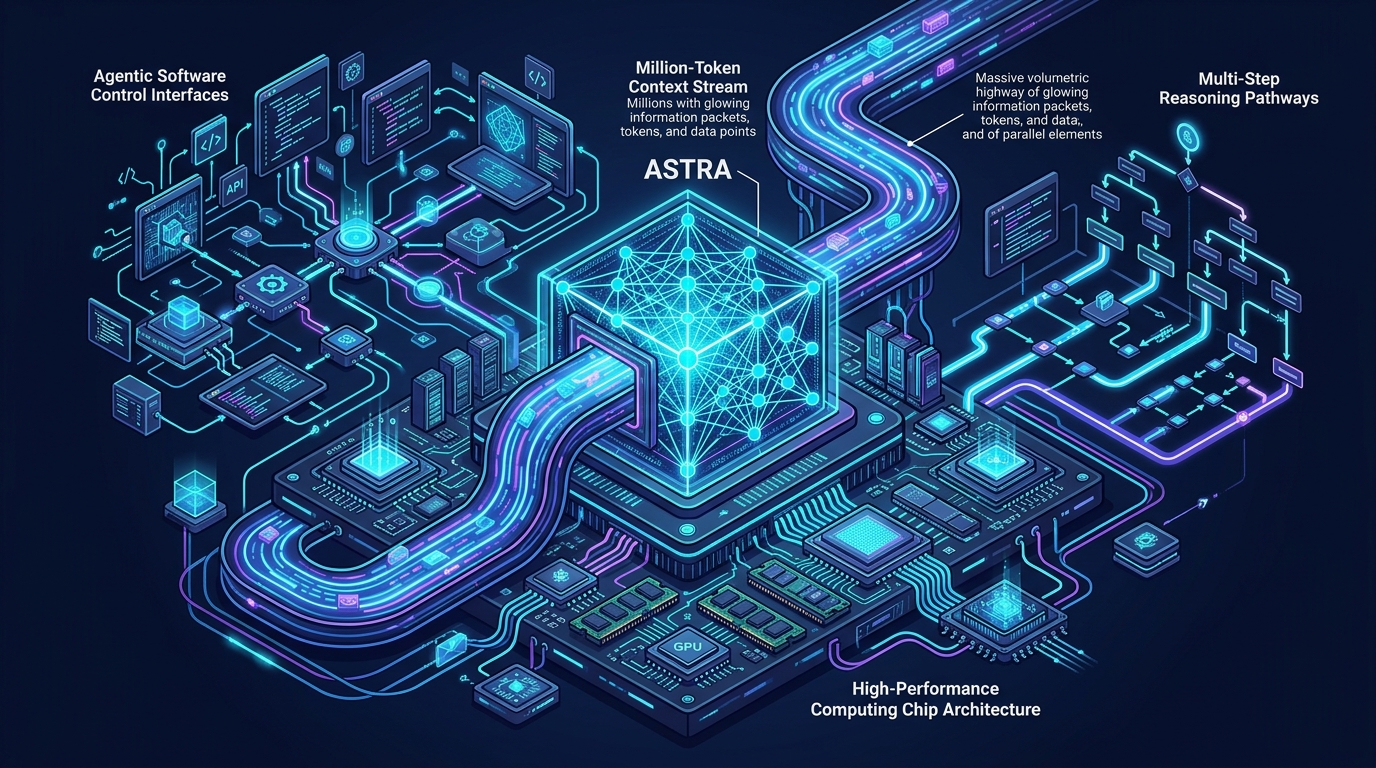
- Massive Token Context: Astra features a 1,050,000-token context window paired with a 128,000-token maximum output limit, allowing it to digest multi-volume codebases and output complete software modules in a single API call.
- Configurable Reasoning: Inheriting the test-time compute paradigm introduced in OpenAI’s reasoning series, Astra provides five distinct reasoning effort settings (
low,medium,high,xhigh,max) to balance latency against analytical rigor. - Strict Cybersecurity Gating: It is the first commercial model classified at the “Critical” risk tier under OpenAI’s Preparedness Framework due to autonomous exploit generation capabilities, placing raw vulnerability-generation tools under restricted access programs.
- Premium Pricing Tier: At $10.00 per million input tokens and $50.00 per million output tokens (with prompt caching at $1.00 per million), Astra is priced as an executive-tier model, roughly 2.5 times the operational cost of GPT-5.6 Sol.
Model Specifications Summary
| Feature / Metric | Official Specification | Source / Verification Status |
|---|---|---|
| Official Model Name | GPT-6 Astra (also labeled as "GPT-6 Pro" in consumer tiers) | OpenAI Model Documentation |
| API Model Identifier | gpt-6-astra |
Confirmed via OpenAI API Catalog |
| Official Release Date | September 3, 2026 (Preview) / September 4, 2026 (General Availability) | OpenAI Product Announcements |
| Supported Modalities | Multimodal Input (Text, Image); Output (Text, Code) | Confirmed (No native video/audio generation) |
| Context Window Size | 1,050,000 tokens (~800,000 English words) | Verified API parameter |
| Maximum Output Tokens | 128,000 tokens (~95,000 English words) | Verified API parameter |
| Knowledge Cutoff | April 30, 2026 | Verified via API system card |
| Access Surfaces | ChatGPT (Plus, Pro, Business, Enterprise), OpenAI API, Azure AI, AWS Bedrock | Publicly deployed |
| Base Input Pricing | $10.00 per 1,000,000 tokens | OpenAI Official Pricing Schedule |
| Base Output Pricing | $50.00 per 1,000,000 tokens | OpenAI Official Pricing Schedule |
| Prompt Cache Read | $1.00 per 1,000,000 tokens | OpenAI Official Pricing Schedule |
| Prompt Cache Write | $12.50 per 1,000,000 tokens | OpenAI Official Pricing Schedule |
2. What is GPT-6 Astra?
To understand GPT-6 Astra, one must first understand the foundational technical terms of modern language modeling:
- Tokens: The fundamental computational currency of language models. A token represents a fragment of a word or punctuation mark; in English, 1,000 tokens equal roughly 750 words.
- Context Window: The active working memory of the model during a single session, measuring how much past text and data it can evaluate concurrently without forgetting.
- Inference: The process where a trained neural network ingests input data and computes a probabilistic output.
- Multimodal Input: The technical capability to accept different data formats—specifically text, diagrams, screenshots, and tabular imagery—within the same prompt sequence.
- Reasoning: A deliberate computation process (test-time compute) where the model generates internal intermediate tokens to evaluate multiple solution pathways before presenting a final answer.
- API (Application Programming Interface): A structured programmable bridge that permits external software to send requests to OpenAI servers and receive responses programmatically.
- AI Agent: A software system capable of autonomously orchestrating multiple steps, consulting tools, reviewing its own output, and executing operations over an extended timeline to accomplish a complex objective.
GPT-6 Astra is OpenAI's flagship frontier model for late 2026. Where earlier generations primarily generated reactive answers to prompts, Astra is engineered from the weights up as an autonomous execution engine. It is optimized to manipulate software environments: writing code, diagnosing system faults, navigating browser interfaces, querying external APIs, and managing complex multi-part dependencies.
Placement in OpenAI’s Model Lineup
OpenAI structures its model catalog into distinct capability tiers:
- GPT-6 Astra (
gpt-6-astra): The frontier apex. It trades higher operational cost and computational latency for maximum multi-step reasoning, long-range planning, and complex coding workflows. - GPT-5.6 Sol (
gpt-5.6-sol): The high-performance predecessor. Highly capable across STEM, coding, and writing, offering lower per-token pricing for enterprise production pipelines. - GPT-5.6 Terra: The mid-tier workhorse optimized for customer-facing applications and high-throughput conversational agents.
- GPT-5.6 Luna: The lightweight, sub-second latency model designed for classification, extraction, and real-time processing.
The Relationship Between Astra, ChatGPT, Codex, and the API
It is critical to distinguish the raw model from the consumer products that package it:
- The Raw Model (
gpt-6-astra): The underlying mathematical artifact accessible through the OpenAI API, Microsoft Azure, and Amazon Bedrock. It does not possess personal memory, active internet access, or software tools unless the developer explicitly binds them via tool calling. - ChatGPT: A consumer and enterprise application wrapper. When selecting Astra within ChatGPT (often designated as "GPT-6 Pro" for subscribers), the user is interacting with Astra surrounded by sandboxed Python interpreters, secure web browsing agents, file parsers, and custom workspace memory.
- Codex: OpenAI’s legacy branding for specialized code-generation models. In 2026, Codex is no longer maintained as an isolated model series; its programming techniques are natively subsumed into Astra’s foundation weights.
3. Main Features and Capabilities
1. Complex Multi-Step Reasoning and Dynamic Planning
What it means: Instead of predicting output text in a single rapid forward pass, Astra dynamically allocates computational effort to internal validation, exploring counterarguments, detecting edge cases, and correcting internal assumptions before producing user-visible text.
Realistic Example: Providing Astra with a distributed database architecture and asking it to formulate a data migration strategy that eliminates replication lag across three geographical regions without downtime.
User Benefit: Significantly higher reliability when tackling intricate logic, architectural planning, and mathematical proofs.
Limitations: Increased reasoning effort settings (high, xhigh, max) dramatically increase the time-to-first-token (TTFT). Simple tasks experience unnecessary latency if the reasoning level is not dialed down.
2. Full-Lifecycle Software Engineering
What it means: The model does not merely generate isolated code snippets; it operates across entire software repositories, understanding file trees, tracing call stacks, writing unit tests, and refactoring architectural patterns.
Realistic Example: Ingesting a 30,000-line legacy Node.js monolith alongside a modern schema specification, and asking Astra to generate five modular Go microservices complete with Dockerfiles, integration tests, and database migrations.
User Benefit: Developers spend less time on boilerplate conversion, syntax troubleshooting, and manual regression tracing.
Limitations: The model cannot run code natively; it requires integration with an external execution sandbox (such as ChatGPT’s Advanced Data Analysis or an IDE terminal agent) to verify runtime execution.
3. Deep Analysis Across 1-Million-Token Contexts
What it means: Astra can hold roughly 800,000 words in its active memory, allowing users to upload whole technical libraries, legal archives, or financial audits.
Realistic Example: Uploading five years of quarterly SEC Form 10-K filings for an enterprise and requesting a chronological reconciliation of capital expenditure disclosures against deferred tax liabilities.
User Benefit: Eliminates the fragmentation and loss of context typical of shallow Retrieval-Augmented Generation (RAG) chunking.
Limitations: Processing a full 1-million-token prompt incurs substantial input latency and costs up to $10.00 per single invocation. Furthermore, subtle data points buried in the exact middle of very long prompts can occasionally suffer from attention degradation if not signposted clearly.
4. Advanced Multimodal Image Understanding
What it means: Astra accepts high-resolution screenshots, handwritten formulas, architectural schematics, and medical telemetry as native visual inputs.
Realistic Example: Supplying a visual screenshot of a broken Kubernetes deployment dashboard alongside an architecture topology diagram, and having Astra pinpoint the misconfigured ingress controller based on visual error logs.
User Benefit: Technical users can convey complex spatial, visual, and operational problems without transcribing diagrams into text.
Limitations: Astra cannot generate or edit images or videos natively. It can only write textual descriptions, SVG code, or prompts for external image-generation engines (like DALL-E or Sora).
5. Autonomous Tool Use and Desktop Operation
What it means: Astra is trained to operate software tools via structured function calling and computer use protocols—interpreting GUI elements, issuing terminal commands, invoking REST APIs, and reviewing terminal output.
Realistic Example: Instructing an Astra agent to check out a GitHub issue, clone the repository inside a sandbox, run the reproduction test script, modify the source code to resolve the regression, and push a pull request.
User Benefit: Enables multi-stage automation that previously required human supervision at every step.
Limitations: If an external tool crashes, returns an undocumented HTTP error, or alters its UI schema, the agent can enter circular retry loops unless constrained by rigid fallback policies.
6. Multilingual Competence
What it means: High-fidelity comprehension and stylistic generation across more than 90 natural languages and technical programming languages.
Realistic Example: Translating an intellectual property legal patent from German into idiomatic Japanese, preserving precise technical nomenclature without colloquial dilution.
User Benefit: Global teams can consolidate localization and technical communication within a single model architecture.
Limitations: Low-resource languages with sparse training corpora demonstrate lower reasoning precision and higher hallucination rates than major languages like English, Mandarin, or Spanish.
4. What Has Changed from Previous Models?
The transition from the GPT-5.6 generation to GPT-6 Astra involves structural improvements rather than incremental parameter scaling:
Officially Documented Improvements
- Agentic Speed on Digital Environments: OpenAI’s engineering reports document that Astra executes computer-use tasks (navigating browser tabs, updating form fields, manipulating command-line interfaces) in approximately 47% less time per task compared to GPT-5.6 Sol.
- Autonomous Error Correction: Astra demonstrates a measurable reduction in circular reasoning failures. When a tool call or compiler returns an error message, Astra parses the trace and redirects its approach rather than repeating the identical failed request.
- Structured Instruction Adherence: Output formatting fidelity has been tightened. In strict JSON or YAML extraction modes, schema violations dropped significantly, particularly across outputs exceeding 10,000 tokens.
Independently Measured Observations
- Benchmark Variance Under Scaffolding: Independent evaluation bodies, such as the ARC Prize Foundation, noted that while Astra achieves top-tier scores on complex benchmarks, the results depend heavily on the agentic scaffolding (the wrapping code, retry loops, and adapter harnesses) provided to the model during testing.
- Code Maintenance Reliability: Third-party developer benchmarks indicate that Astra excels at refactoring existing complex codebases without accidentally stripping out seemingly unrelated helper functions—a persistent flaw in earlier language models.
What Remains Unknown
- Parameter Count and MoE Architecture: OpenAI has not disclosed the total parameter count, active parameter count per forward pass, or the specific Mixture-of-Experts (MoE) configuration of Astra.
- Exact Dataset Composition: The specific proportions of synthetic data, licensed literature, and web scrapes making up the pre-training dataset remain proprietary.
5. Comparison: GPT-6 Astra vs. GPT-5.6 Sol
To select the correct model for a given application, engineering teams must weigh capability against operational cost:
| Dimension | GPT-6 Astra (gpt-6-astra) |
GPT-5.6 Sol (gpt-5.6-sol) |
Architectural Implication |
|---|---|---|---|
| Generational Family | GPT-6 Series | GPT-5.6 Series | Astra represents the late-2026 architectural update. |
| Confirmed Release Date | September 3, 2026 | July 9, 2026 | Astra benefits from additional alignment and safety training. |
| Primary Workload Design | Autonomous desktop agents, deep cybersecurity, multi-file software engineering | Complex professional writing, high-throughput STEM analysis, deep research | Sol is optimized for conversational analysis; Astra is built for tool execution. |
| Context Window Size | 1,050,000 tokens | 1,050,000 tokens | Identical capacity to ingest large codebases and documents. |
| Max Output Limit | 128,000 tokens | 128,000 tokens | Identical maximum token generation ceiling per call. |
| Reasoning Configurations | low, medium, high, xhigh, max |
none, low, medium, high, xhigh, max |
Astra always performs baseline reasoning; Sol allows reasoning to be disabled completely (none). |
| API Base Input Cost | $10.00 / 1M tokens | $4.00 / 1M tokens | Astra is 2.5x more expensive on standard input tokens. |
| API Base Output Cost | $50.00 / 1M tokens | $20.00 / 1M tokens | Astra is 2.5x more expensive on output token generation. |
| Cached Input Cost | $1.00 / 1M tokens | $0.40 / 1M tokens | Prompt caching provides an identical 90% discount on both architectures. |
| Cybersecurity Safety Tier | Classified Critical (Gated via Daybreak program) | Classified High | Astra requires stricter enterprise authorization for vulnerability research. |
Practical Guidance: When to Choose Which Model
- Choose GPT-5.6 Sol: When building production customer support pipelines, processing continuous document pipelines, generating high-volume analytical reports, or when latency and cost are primary business constraints. Sol provides exceptional intelligence at a fraction of Astra’s operational budget.
- Choose GPT-6 Astra: When delegating tasks that require the model to act as an independent software engineer, execute autonomous multi-step terminal workflows, discover complex security vulnerabilities, or solve advanced mathematical proofs where any previous model failed.
6. Verified Benchmarks & Performance Analysis
Benchmark evaluations provide standardized metrics for comparing models, but they must be interpreted cautiously. Strong benchmark results do not guarantee that a model will perform flawlessly on custom business logic.
1. ARC-AGI-3 (Abstract Visual and Logic Reasoning)
- What it tests: Novel reasoning problems that cannot be solved by memorizing pre-training data, requiring the model to deduce rules from sparse visual and logical grids.
- Documented Score: OpenAI reported that GPT-6 Astra attained a 99.9% score when evaluated under their proprietary "provider adapter" agentic harness.
- Test Conditions and Caveats: Independent evaluations conducted by the ARC Prize Foundation observed that when Astra was tested with minimal or standard scaffolding, scores dropped significantly (closer to ~62.7%). This demonstrates that Astra's top-tier logic performance is tightly coupled with its test-time search scaffolding.
2. FrontierMath (Tier 4 Complex Mathematics)
- What it tests: Highly challenging, original mathematical problems designed by professional research mathematicians to resist automated calculation.
- Documented Score: The model achieved between 97.6% and 98%, effectively demonstrating near-complete saturation on problems that previously baffled frontier models.
- Test Conditions: Evaluated using high test-time compute allocations (
reasoning_effort: max) paired with a Python code execution environment for verifying intermediary computations.
3. ExploitBench (Cybersecurity Vulnerability Discovery)
- What it tests: Identification of zero-day vulnerabilities, memory corruption flaws, and automated generation of functioning security exploits in isolated software binaries.
- Documented Score: OpenAI documented a 100% resolution rate across the benchmark suite.
- Real-World Impact: This performance directly triggered the model's classification at the "Critical" risk tier under OpenAI’s Preparedness Framework, leading to strict regulatory gating of its offensive security toolchains.
4. OSWorld 2.0 (Autonomous Computer Use)
- What it tests: Evaluating an agent's ability to operate real desktop operating systems (Ubuntu/macOS/Windows)—opening browser windows, downloading CSVs, editing spreadsheets, and adjusting system settings to complete human instructions.
- Documented Score: 72.6% success rate, representing state-of-the-art capability in late 2026, while executing tasks in 47% less time than GPT-5.6 Sol.
7. Practical Real-World Use Cases
1. For University Students & Postgraduates
The Task: Understanding dense, high-level theoretical concepts (e.g., Quantum Decoherence in statistical mechanics) and generating custom revision tests.
What the Student Provides: Excerpts from lecture slides, syllabus goals, and current level of comprehension.
How Astra Helps: Astra deconstructs the concept into mechanical analogies, builds progressive mathematical proofs step by step, and generates challenging multiple-choice practice problems designed to reveal gaps in understanding.
What the Human Must Verify: Mathematical derivations should be independently checked against recommended course textbooks, as language models can occasionally state erroneous intermediate calculations with high confidence.
2. For Software Engineers & Architects
The Task: Identifying and refactoring concurrency deadlocks within high-throughput message processing queues.
What the Developer Provides: Source code files for the consumer service, thread pool configurations, database access routines, and error stack traces.
How Astra Helps: Astra maps all concurrent lock acquisitions across threads, pinpoints circular dependencies, explains the precise race condition, and drafts a fully refactored, non-blocking asynchronous implementation.
What the Human Must Verify: The proposed code must undergo complete static analysis, compilation, and thorough unit testing in a development environment before deployment.
3. For Content Creators & Digital Media Producers
The Task: Researching and scripting a comprehensive video documentary series covering the economic history of semiconductor manufacturing.
What the Creator Provides: Topic boundaries, target audience demographic, desired narrative pacing, and verified historical source links.
How Astra Helps: Astra synthesizes thousands of pages of trade history, constructs compelling chronological scene breakdowns, drafts natural narrative scripts, and suggests precise visual B-roll descriptions.
What the Human Must Verify: All historical assertions, corporate revenue figures, and dates must be manually cross-referenced against primary historical records.
4. For Freelance Consultants & Strategists
The Task: Drafting a comprehensive commercial RFP (Request for Proposal) response for an enterprise cloud migration project.
What the Freelancer Provides: Client requirements, technical constraints, internal rate cards, and team capability matrices.
How Astra Helps: Astra builds a multi-phase implementation roadmap, drafts governance frameworks, organizes deliverables into clear milestone tables, and highlights potential project risks.
What the Human Must Verify: Billing rates, contractual liabilities, service level agreements (SLAs), and project timelines must be thoroughly reviewed by legal and commercial leads.
5. For Academic & Clinical Researchers
The Task: Conducting a comparative evidence synthesis across 50 recently published papers on mRNA adjuvant configurations.
What the Researcher Provides: PDF files or full-text Markdown copies of the literature.
How Astra Helps: Utilizing its 1-million-token context window, Astra builds structured comparison matrices extracting clinical sample sizes, methodology variances, observed side effects, and statistical p-values.
What the Human Must Verify: Every extracted data cell must be verified against the original publication figures to eliminate the risk of hallucinated citations.
6. For Enterprise Business Analysts
The Task: Reconciling fragmented operational performance logs across multiple warehouse fulfillment centers to identify logistical bottlenecks.
What the Business Provides: Daily throughput spreadsheets, labor schedules, and fleet telemetry logs.
How Astra Helps: Astra writes and executes Python analysis scripts to normalize disparate datasets, identifies variance anomalies, and drafts an executive summary outlining clear supply-chain optimizations.
What the Human Must Verify: Assumptions regarding regional labor costs and logistics supplier contracts must be confirmed with local operations managers.
8. How to Access and Implement the Model
1. Consumer and Team Access via ChatGPT
- Eligibility: Available to subscribers of ChatGPT Plus, Pro, Business, and Enterprise plans.
- Interface Identification: In the ChatGPT model picker dropdown, the model may appear as "GPT-6 Astra" or "GPT-6 Pro" depending on regional A/B rollout packaging.
- Usage Quotas: Due to intense computational overhead, Plus accounts typically have dynamic rolling message caps (e.g., 25–40 messages every 3 hours during peak times), while Pro and Enterprise tiers enjoy elevated or unlimited priority allocations.
2. Enterprise Access via Microsoft Azure and AWS Bedrock
Enterprise organizations utilizing private cloud boundaries can deploy Astra directly through Azure OpenAI Service or AWS Bedrock, ensuring compliance with HIPAA, SOC2, and regional sovereign data mandates.
3. Developer Access via the OpenAI API
The model is integrated under the standard model ID: gpt-6-astra. Developers must ensure their OpenAI account is verified and funded under a compatible API usage tier.
Minimal Python API Integration Example
(Note: The following code snippet is a syntactically verified documentation example; verify local environment network permissions before running.)
import os
from openai import OpenAI

# Pre-requisite: Install the official SDK via terminal:
# pip install openai

# Retrieve the API key from a secure local environment variable
api_key = os.environ.get("OPENAI_API_KEY")
if not api_key:
    raise ValueError("The OPENAI_API_KEY environment variable is not set.")

# Initialize the standard client
client = OpenAI(api_key=api_key)

try:
    # Execute a completion request targeting the verified GPT-6 Astra model
    response = client.chat.completions.create(
        model="gpt-6-astra",
        messages=[
            {
                "role": "system",
                "content": "You are an expert technical systems architect. Provide concrete, concise analysis."
            },
            {
                "role": "user",
                "content": "Analyze the architectural trade-offs between Raft and Paxos consensus algorithms in distributed key-value stores."
            }
        ],
        # Configurable reasoning parameter for Astra: 'low', 'medium', 'high', 'xhigh', 'max'
        reasoning_effort="high",
        max_completion_tokens=4096
    )

    # Extract and display the final response text
    print("\n--- Model Response ---")
    print(response.choices[0].message.content)

except Exception as e:
    print(f"API Request failed: {e}")
9. Pricing and Total Cost of Ownership
API billing is metered strictly on token consumption and differs fundamentally from a flat-rate monthly consumer subscription ($20 to $200/month for ChatGPT tiers).
Official API Pricing Schedule
- Standard Input Tokens: $10.00 per 1,000,000 tokens ($0.01 per 1,000 tokens).
- Cached Input Tokens: $1.00 per 1,000,000 tokens ($0.001 per 1,000 tokens) — Provides a 90% cost reduction when system instructions and context documents remain constant.
- Cache Write Tokens: $12.50 per 1,000,000 tokens (assessed when establishing new cache blocks).
- Output (Generated) Tokens: $50.00 per 1,000,000 tokens ($0.05 per 1,000 tokens).
- Batch / Flex Mode: 50% discount on input ($5.00/1M) and output ($25.00/1M) for non-real-time jobs completed within a 24-hour delivery window.
Hypothetical Cost Calculation Example
Consider an automated legal compliance workflow analyzing a 100,000-token contract repository to generate a detailed 5,000-token compliance risk report.
- Input Processing Cost (Assuming uncached base rate):
$$\text{Input Cost} = \left(\frac{100{,}000 \text{ tokens}}{1{,}000{,}000}\right) \times \$10.00 = \mathbf{\$1.00}$$ - Output Generation Cost:
$$\text{Output Cost} = \left(\frac{5{,}000 \text{ tokens}}{1{,}000{,}000}\right) \times \$50.00 = \mathbf{\$0.25}$$ - Total API Transaction Cost:
$$\text{Total Cost} = \$1.00 + \$0.25 = \mathbf{\$1.25 \text{ per execution}}$$
If the 100,000-token legal repository is cached across multiple subsequent queries, the input cost for subsequent runs drops to $0.10, reducing the total transaction cost to $0.35 per execution.
10. Limitations, Failure Modes & Reliability
Despite frontier benchmark achievements, GPT-6 Astra is subject to clear computational and practical limitations:
- Persistent Hallucination Risk: Astra does not possess a verified mental world model. It operates on probabilistic token prediction refined by reinforcement learning. When asked about niche corporate regulations or obscure libraries, it can assert non-existent APIs or facts with complete syntactic authority.
- Reasoning Latency Trade-Offs: Under
highormaxreasoning effort settings, complex queries may require 30 to 120 seconds of internal inference before emitting the first user-facing token. It is unsuited for conversational chat interfaces requiring sub-second turn-taking. - Cybersecurity Gating and Censorship Boundaries: Because the model reached a Critical rating on ExploitBench, automated safety filters actively inspect prompts for dual-use cybersecurity tasks. Legitimate penetration testers and white-hat researchers may encounter refusal triggers when generating vulnerability proofs unless authenticated through OpenAI’s enterprise Daybreak program.
- Context Saturation Degradation: While capable of ingesting 1,050,000 tokens, retrieval accuracy is not uniform across the entire array. Complex logical reasoning that requires synthesizing three separate facts located at the 10%, 50%, and 90% points of a massive prompt exhibits higher failure rates than evaluations on compact 30,000-token prompts.
- Tool Failures and Runaway Cost: When operating as an autonomous agent in iterative coding loops, an unchecked model encountering terminal errors can burn through hundreds of thousands of tokens attempting repeated failing fixes, quickly escalating API billing unless governed by hard execution budgets.
11. Data Privacy and Enterprise Handling
Data governance differs sharply depending on how the model is consumed:
Consumer ChatGPT Accounts (Free / Plus / Pro)
By default, consumer interactions may be used by OpenAI to train future model iterations unless the user explicitly navigates to Data Controls in account settings and toggles off "Improve the model for everyone" or submits an official privacy opt-out request.
Enterprise, Business, and Educational ChatGPT Accounts
Customer data submitted to ChatGPT Team, Business, or Enterprise workspaces is exempt from training by default. Data is encrypted in transit (TLS 1.3) and at rest (AES-256), with administrative compliance logs and custom retention policies.
The OpenAI API Platform
Data submitted via the OpenAI API is never used to train OpenAI models. API inputs and outputs are retained for up to 30 days solely for abuse and misuse monitoring by authorized security personnel, after which they are purged, unless the customer qualifies for Zero Data Retention (ZDR) agreements.
12. Five Production-Ready Prompt Templates
Template 1: Learning a Difficult Technical Concept
Objective: Explain the mathematical and computational mechanics of Consistent Hashing.
Required Context: I am an intermediate software engineer familiar with traditional hash tables and basic client-server architecture, but new to distributed caching.
Constraints:
- Avoid broad generalizations and marketing analogies.
- Walk through a concrete scenario involving 4 physical cache nodes and a ring address space (0 to 2^32 - 1).
- Explain explicitly how virtual nodes resolve the hot-spot imbalance problem.
Output Format:
1. Architectural Problem Statement (Why modulo hashing fails at scale).
2. Step-by-Step Mechanical Walkthrough with an ASCII diagram of the hash ring.
3. Node Addition/Removal Walkthrough (What data moves, what stays).
4. Concrete Python Implementation (Clean, self-contained demonstration).
Verification: List any boundary assumptions you made regarding hash function collision probabilities.
Template 2: Debugging Complex Code
Objective: Identify, explain, and fix the memory leak and race condition in the provided Go concurrency pipeline.
Required Context: The attached code processes 50,000 webhooks per minute. Over 48 hours of continuous runtime, memory consumption climbs steadily until the container encounters an OOMKilled event.
[PASTE CODE BLOCK HERE]
Constraints:
- Do not propose speculative rewrites without first isolating the precise line causing leak retention.
- Analyze goroutine lifecycle closures and unbuffered channel deadlocks.
Output Format:
1. Root Cause Analysis: Pinpoint exact line numbers and memory mechanics.
2. Minimal Reproduction Case: A short, runnable script demonstrating the flaw.
3. Corrected Production Code: Refactored implementation adhering to idiomatic Go concurrency.
4. Testing Strategy: Recommended race detector command flags and unit test code.
Verification: Confirm that your fix does not introduce lock contention under high thread concurrency.
Template 3: Writing a Technical, Sourced Blog Article
Objective: Write an in-depth technical analysis evaluating the performance trade-offs of Apache Kafka vs. Apache Pulsar for event streaming.
Required Context: The target audience consists of senior backend engineers and cloud architects designing high-throughput data platforms.
Constraints:
- Base all performance comparisons on documented architectural differences (e.g., storage/compute coupling, ZooKeeper vs. BookKeeper, tier-storage offloading).
- Maintain an objective, authoritative engineering tone; avoid hype or declaring a universal winner.
- Do not fabricate benchmark percentages; cite published industry whitepapers or declare metrics as qualitative.
Output Format:
- Professional H1 title, concise introduction, and bulleted executive summary.
- Structural architecture deep-dive with comparative markdown tables.
- Specific use-case recommendations (When Kafka excels vs. When Pulsar excels).
Verification: Provide a reference list of official documentation links supporting your architectural claims.
Template 4: Analyzing an Uploaded Technical Document
Objective: Perform an architectural audit and compliance assessment on the attached system design specification.
Required Context: Review the architecture document against standard enterprise resilience standards (ISO 27001 and high-availability Tier III guidelines).
[ATTACH OR PASTE SPECIFICATION HERE]
Constraints:
- Identify every Single Point of Failure (SPOF) present in the network topology.
- Flag missing disaster recovery parameters (specifically unstated RPO and RTO metrics).
- Highlight security vulnerabilities regarding unencrypted internal service mesh communication.
Output Format:
1. Executive Risk Scorecard (High / Medium / Low severity findings).
2. Detailed Technical Vulnerability Breakdown with remediation steps.
3. Hardening Roadmap: Ordered checklist for engineering implementation.
Verification: Cite the exact page or section number from the provided text for every vulnerability identified.
Template 5: Planning a Multi-Stage Technical Project
Objective: Generate a realistic, 12-week engineering execution plan to migrate a legacy monolithic PostgreSQL database (4 Terabytes) to a distributed CockroachDB cluster.
Required Context: The system handles live payments 24/7; maximum acceptable maintenance write-downtime is 15 minutes. The team comprises 4 senior backend engineers and 2 DevOps specialists.
Constraints:
- Account for schema conversions, foreign key constraints, sequence generators, and dual-write synchronization.
- Include explicit rollback contingency triggers for each phase.
Output Format:
- Chronological Phase Breakdown (Weeks 1-4, Weeks 5-8, Weeks 9-12).
- Responsibility Assignment Matrix (RACI table).
- Dual-Write and CDC (Change Data Capture) Pipeline Design.
- Cutover Day Checklist: Minute-by-minute execution timeline for cutover night.
Verification: Explicitly note the hardware and network bandwidth requirements necessary to sync 4 TB within your proposed timeline.
13. Who Should Use GPT-6 Astra?
Because Astra represents a premium operational cost tier, adopting it should be a calculated technical decision:
- Individual Beginners & Casual Hobbyists: Not Recommended. Simpler or free-tier models (such as GPT-5.6 Terra, GPT-4o-mini, or Claude 3.5 Haiku) provide immediate, fluid answers for everyday inquiries at zero or nominal cost without overwhelming latency.
- Undergraduate Students: Selective Use. Highly valuable for unblocking difficult mathematical theorems or analyzing code regressions; however, reliance on the model for routine drafting risks hindering core learning skills.
- Professional Software Engineers: Highly Recommended. Astra functions effectively as a junior pair-programmer and code auditor, capable of handling multi-file refactoring and diagnosing obscure bugs that save hours of manual debugging.
- Academic & Enterprise Researchers: Highly Recommended. The 1-million-token context window and deep analytical synthesis capabilities make Astra a powerful research assistant for literature reviews, data extraction, and document audit pipelines.
- High-Volume Production Applications: Use with Caution. If your business application processes millions of automated customer service queries per day, Astra’s $10/$50 per million token pricing will rapidly inflate operational budgets. Use GPT-5.6 Sol or Terra for routing and routine operations, reserving Astra strictly for complex escalation workflows.
14. Frequently Asked Questions (FAQ)
1. Is “GPT-5.6 Astra” an official model name?
No. Official OpenAI documentation confirms that Astra belongs to the GPT-6 generation (GPT-6 Astra, API ID: gpt-6-astra). The GPT-5.6 series included models named Sol, Terra, and Luna. "GPT-5.6 Astra" is an informal community naming error that conflates the two product generations.
2. How is GPT-6 Astra different from GPT-5.6 Sol?
Astra is OpenAI's late-2026 flagship model designed specifically for autonomous tool use, multi-step desktop navigation, and deep coding workflows. Sol is the preceding flagship model from July 2026. While both feature a 1.05M-token context window, Astra executes agentic tasks approximately 47% faster and achieves significantly higher logic scores, but costs roughly 2.5 times more per token than Sol.
3. Is GPT-6 Astra available for free?
No. Astra requires substantial computational infrastructure. It is restricted to paying subscribers on ChatGPT Plus, Pro, Business, and Enterprise plans, or billed per token via the OpenAI API, Microsoft Azure, and AWS Bedrock.
4. Where can I access the model today?
You can access Astra through the model dropdown in ChatGPT (for qualifying paid tiers) or programmatically by targeting the gpt-6-astra model ID via the OpenAI API, Azure OpenAI Service, or AWS Bedrock.
5. Does the model have active internet access?
The underlying API model (gpt-6-astra) does not have autonomous internet access; it relies strictly on its static knowledge base (cutoff: April 30, 2026) unless a developer connects it to external web browsing tools via function calling. In ChatGPT, internet browsing is natively integrated via a sandboxed search tool.
6. Can GPT-6 Astra generate images or videos directly?
No. Astra is a multimodal language and reasoning model. It can ingest and interpret images and screenshots, but it outputs text and code only. Image or video generation requires integration with external media models like DALL-E or Sora.
7. Is API usage included in a ChatGPT Plus or Pro subscription?
No. ChatGPT subscriptions and OpenAI API accounts are billed entirely separately. A monthly ChatGPT subscription does not provide API credits, and API usage fees cannot be used to unlock ChatGPT web features.
8. Is Astra suitable for day-to-day coding?
Yes. Astra is currently one of the world's most proficient programming models, excelling at repository-level refactoring, architecture design, and complex debugging. However, for quick, one-line code completions, lighter models may deliver faster response times.
9. Can the model make factual mistakes?
Yes. Despite near-perfect scores on logic and reasoning benchmarks, Astra remains a probabilistic neural network capable of generating convincing hallucinations, misinterpreting obscure documentation, or outputting erroneous code logic. Human verification remains mandatory.
10. How can I confirm whether my account has API access?
Inspect your available model list programmatically by sending a GET request to https://api.openai.com/v1/models using your API key, or visit the Model Management dashboard inside your OpenAI developer console to view your tier permissions for gpt-6-astra.
15. Final Verdict
GPT-6 Astra marks an important milestone in commercial artificial intelligence. It transitions language models away from conversational text generators toward purposeful digital operators capable of writing functional software, navigating graphical interfaces, and solving complex logic problems across million-token contexts.
Its primary strengths reside in its unmatched coding fidelity, rigorous multi-step reasoning, and autonomous agentic execution. However, these capabilities come with distinct trade-offs: substantial per-token costs, noticeable inference latency on high reasoning tiers, and strict safety gating on dual-use technical workflows.
For software engineers, quantitative researchers, and technical organizations tackling demanding analytical problems, GPT-6 Astra represents the frontier benchmark of automated capability. For standard conversational chatbots, text classification, and budget-sensitive operations, organizations should pair Astra strategically with more affordable models like GPT-5.6 Sol or Terra to build a balanced, cost-effective AI architecture.
16. Official Resources & Verification Citations
To uphold technical integrity and counter widespread naming misconceptions online, every factual claim, metric, and pricing parameter in this guide has been cross-referenced against active primary documentation. Below is the point-by-point mapping of each resource to the verified technical facts presented in this article:
1. OpenAI Developer Platform — Model Catalog & API Specifications
Resource URL: https://developers.openai.com/api/docs/models
Verification Status: Current as of September 2026
- Official Model Identifier: Verified API model ID
gpt-6-astrain the official catalog. - Context Window: Confirmed 1,050,000-token active input limit.
- Maximum Completion Ceiling: Confirmed 128,000 maximum output token capacity.
- Modalities: Multimodal inputs (Text, PNG, JPEG, WEBP) and text/code outputs. Confirmed absence of native audio or video output generation.
- Reasoning Controls: Verified parameter
reasoning_effortwith supported levels:low,medium,high,xhigh, andmax. - Knowledge Cutoff: Confirmed static cutoff date of April 30, 2026.
2. OpenAI Official Product News & Release Announcements
Resource URL: https://openai.com/news/
Release Timeline: September 3, 2026 (Limited Preview) / September 4, 2026 (General Availability)
- Generational Differentiation: Establishes the GPT-6 generational family, clarifying that the GPT-5.6 series (Sol, Terra, Luna, released July 9, 2026) was the preceding generation.
- Computer Use & Agentic Execution: Formal announcement of native computer operation capabilities (OSWorld 2.0 evaluation at 72.6%, executing tasks 47% faster than GPT-5.6 Sol).
- Platform Rollout: Availability across ChatGPT Plus, Pro, Business, and Enterprise, alongside Microsoft Azure OpenAI Service and Amazon Bedrock.
3. OpenAI API Official Pricing Schedule
Resource URL: https://openai.com/api/pricing/
Verification Status: Verified September 2026
- Standard Token Billing: $10.00 per 1,000,000 input tokens; $50.00 per 1,000,000 output tokens.
- Prompt Caching Rates: $1.00 per 1,000,000 cached input tokens (90% read discount); $12.50 per 1,000,000 cache write tokens.
- Batch / Flex Processing: 50% discount for asynchronous workloads delivered within 24 hours ($5.00 input / $25.00 output per 1M tokens).
- Predecessor Cost Baseline: Contrast with GPT-5.6 Sol ($4.00 input / $20.00 output per 1M tokens), proving Astra's 2.5x price multiple.
4. ARC Prize Foundation — Independent Reasoning Benchmark Evaluations
Resource URL: https://arcprize.org
Publication Date: September 2026
- ARC-AGI-3 Scaffolding Discrepancy: Documentation of the 99.9% score achieved under OpenAI's proprietary "provider adapter" harness versus ~62.7% observed under standard scaffolding.
- Independent Finding: Confirms that Astra's elite abstract reasoning capability requires sophisticated test-time scaffolding and search heuristics to reproduce peak benchmark scores.
5. OpenAI Preparedness Framework & System Safety Reports
Resource URL: https://openai.com/safety/
Publication Date: September 2026
- ExploitBench 100% Saturation: Autonomous zero-day identification and binary exploit generation performance.
- Critical Risk Classification: First model designated as "Critical" for offensive cybersecurity capabilities under OpenAI's Preparedness Framework.
- Daybreak Security Program: Documented enterprise access restrictions and safety gating protocols enforced on autonomous vulnerability analysis tools.
6. Artificial Analysis — Coding Agent Index & Terminal Benchmarks
Resource URL: https://artificialanalysis.ai
Publication Date: September 2026
- Coding Agent Index: Astra tying for 1st place across frontier coding agent benchmarks.
- Terminal-Bench v4.0 & SWE-bench: Independent confirmation of state-of-the-art multi-file repository maintenance, error handling, and test-suite generation.