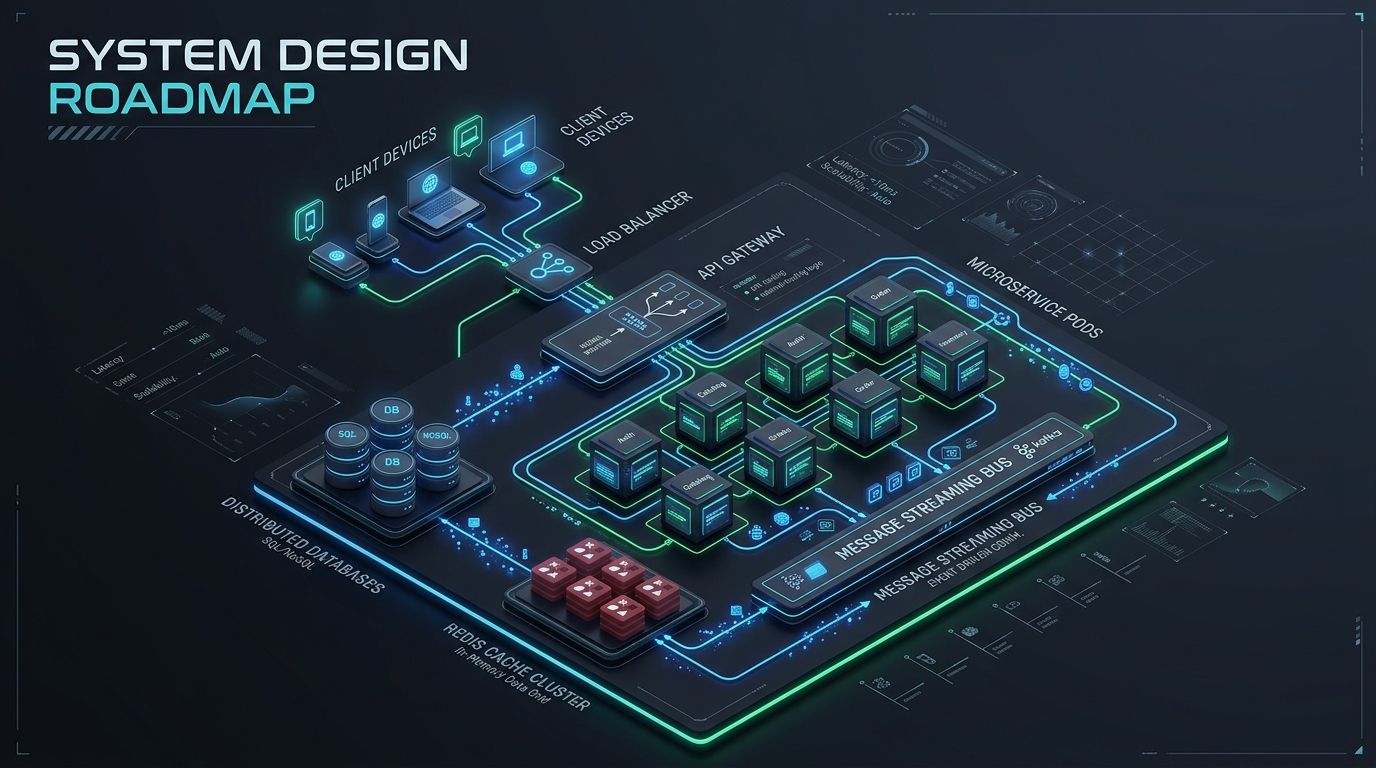
You can write clean endpoints, build responsive user interfaces, and wire up database queries without breaking a sweat. Yet the moment a technical interviewer sketches an empty box on a whiteboard and asks, "How would you design a system that handles fifty million active users?", your mind freezes. Or perhaps your production server just experienced a traffic surge, the primary database hit maximum connection limits, and you had no systematic framework to diagnose what went wrong.
System design is the deliberate process of defining the architecture, components, modules, interfaces, and data flows of a software system to satisfy specified performance, reliability, and business requirements. Rather than focusing on syntax or frameworks, system design centers on assembling building blocks so that an application remains available, fast, and maintainable as traffic increases.
Mastering this discipline is the single biggest inflection point in moving from an individual contributor writing feature tickets to a senior or staff engineer who shapes organizational technical direction. High-growth tech companies evaluate system design because it demonstrates whether you build software that survives real-world chaos or software that collapses the moment customers arrive.
This system design roadmap provides a linear, five-phase progression. You will move from core networking fundamentals to data persistence, distributed communication, operational resilience, and finally interview execution.
Phase 1 — Foundations (Networking & Core Concepts)
Every distributed system is fundamentally software running on multiple machines talking across physical networks. If you do not understand the transport layer and foundational constraints of machines communicating over cables, higher-level architecture will feel like arbitrary magic.
- Client-server model: A distributed architecture structure where service providers (servers) manage resources and service requesters (clients) initiate requests.
- IP addresses, DNS, ports, and NAT: DNS translates human domain names into IP addresses, ports identify specific network processes, and NAT (Network Address Translation) maps multiple private local IP addresses to a single public IP.
- HTTP vs HTTPS: HTTP transfers plain text application data, whereas HTTPS establishes an encrypted TLS channel to guarantee confidentiality and data integrity.
- TCP vs UDP: TCP guarantees ordered, reliable packet delivery with congestion control, while UDP transmits packets without handshake overhead or delivery guarantees, prioritizing speed over reliability.
- Latency, bandwidth, and throughput: Latency is the time required for a packet to travel between two points; bandwidth is the maximum data capacity of the link; throughput is the actual rate of data processed over time.
- Vertical vs horizontal scaling: Vertical scaling upgrades CPU, RAM, or storage on a single host, whereas horizontal scaling adds additional machines to distribute computational workload.
- Load balancers: Reverse proxies such as NGINX, HAProxy, or cloud load balancers that distribute incoming requests across a server pool using algorithms like round-robin or least connections.
- Single point of failure (SPOF): Any single component whose failure stops the entire system from operating.
- Availability, reliability, and fault tolerance: Availability is the percentage of time a system is operational; reliability is the probability that it performs its required function without failure; fault tolerance is the ability to continue operating despite hardware or component crashes.
- Stateful vs stateless design: Stateless design treats every incoming request as independent without retaining session state on the server, making horizontal scaling simple and predictable.
Why this phase matters: If you cannot explain what happens from the moment a user presses enter in their browser to the point a response payload returns, you cannot design resilient systems. Senior engineers and interviewers test these concepts first to confirm you understand physical network boundaries before debating microservices.
How to practice:
- Configure NGINX locally on your machine as a reverse proxy load balancer distributing incoming traffic across two simple Node.js or Python backend instances.
- Use
curl -v,traceroute, and your browser network tab to inspect DNS lookup timings, TLS handshakes, and response header latency breakdowns.
Recommended resource type: A foundational computer networking course or a practical guide covering TCP/IP protocols and web performance engineering.
Phase 2 — Data & Storage
Application logic is easily replaced or scaled horizontally; persistent data is where systems encounter hard physical bottlenecks and complex consistency guarantees.
- Relational vs NoSQL databases: Relational databases enforce strict schemas, relationships, and foreign keys, while NoSQL databases (document, key-value, column-family, graph) prioritize flexible schemas and distributed scaling.
- Database indexing: Data structures such as B-Trees and Hash maps that drastically speed up data retrieval queries at the cost of additional storage and write overhead.
- Normalization vs denormalization: Normalization eliminates duplicate records to protect data integrity; denormalization intentionally duplicates fields to avoid expensive table joins in high-read environments.
- Replication: Copying data across multiple database instances (leader-follower or multi-leader) to achieve high read throughput and failover redundancy.
- Sharding and partitioning: Dividing a massive database horizontally across distinct hardware nodes by a specific partition key to overcome single-machine storage and IOPS limits.
- Caching strategies: In-memory data stores like Redis and Memcached, Content Delivery Networks (CDNs) for static assets, and patterns like cache-aside, write-through, write-behind, and refresh-ahead.
- Cache invalidation: The mechanism of purging stale data from cache when the underlying database record updates, navigating the challenges of cache stampedes and TTL expirations.
- CAP theorem: A foundational theorem stating that a distributed data store can simultaneously guarantee at most two out of three properties: Consistency, Availability, and Partition Tolerance.
- ACID vs BASE: ACID (Atomicity, Consistency, Isolation, Durability) guarantees strict transactional correctness, whereas BASE (Basically Available, Soft state, Eventual consistency) accepts loose consistency in exchange for distributed availability.
Why this phase matters: Most real-world production outages stem from database deadlocks, slow full-table scans, unindexed queries, or stale caches. Selecting the wrong storage engine or partitioning key early in a project creates technical debt that can take years to reverse.
How to practice:
- Populate a local PostgreSQL table with five million fake records, run unindexed search queries with
EXPLAIN ANALYZE, add a composite index, and record the execution time improvement. - Set up a local Redis instance and implement the cache-aside pattern with a TTL inside a simple CRUD application, then simulate cache eviction under load.
Recommended resource type: A comprehensive reference book on database internals, storage engine structures, and distributed data modeling.
Phase 3 — Distributed Systems & Communication
Once your application outgrows a single machine and a single database, services must exchange information reliably across network boundaries.
- Microservices vs monoliths: Monolithic architecture bundles all functional modules into a single deployment binary; microservice architecture isolates capabilities into independently deployable, networked services.
- API gateways: A dedicated reverse proxy entry point that handles routing, SSL termination, client authentication, and request transformation for backend services.
- Message queues: Asynchronous communication buffers like Apache Kafka, RabbitMQ, and AWS SQS that decouple message producers from consumers.
- Event-driven architecture: A design paradigm where decoupled components react asynchronously to state changes (events) emitted across the system.
- Service discovery: Centralized registries (such as Consul or Eureka) that let services dynamically find the network locations of healthy peer instances.
- Synchronous vs asynchronous communication: Synchronous communication (HTTP, gRPC) blocks the caller while waiting for an immediate response; asynchronous communication (queues, pub/sub) returns immediately while workers process tasks in the background.
- Idempotency: The design property ensuring that an operation produces identical side effects regardless of whether it is executed once or multiple times.
- Eventual consistency: A consistency model guaranteeing that, given no new updates, all distributed replicas will eventually converge to the same value.
Why this phase matters: Distributed networks fail routinely; routers drop packets, services restart, and downstream dependencies slow down. Understanding asynchronous decoupling and idempotency prevents data corruption and prevents cascading outages across services.
How to practice:
- Build an order checkout endpoint that synchronously writes an order record to a database and pushes an "order.created" event to a local RabbitMQ or Redis queue for an asynchronous email worker to process.
- Simulate network duplicate delivery by publishing the same event five times, and write consumer code using unique idempotency keys to ensure the customer is charged only once.
Recommended resource type: A distributed systems guide focusing on event-driven architecture and asynchronous message streaming patterns.
Phase 4 — Scale, Reliability & Operations
A functional architecture diagram is useless if your system falls apart when an unexpected traffic spike strikes or a cloud provider availability zone goes offline.
- Rate limiting and throttling: Defensive mechanisms using algorithms like Token Bucket or Leaky Bucket to cap the volume of incoming requests per client or IP address.
- Circuit breakers and exponential backoff: Design patterns that halt outbound calls to failing downstream dependencies to prevent resource exhaustion, combined with progressively increasing retry intervals.
- Observability (logging, metrics, and tracing): Structured logging records point-in-time events; metrics track numerical health indicators like CPU and error rates; distributed tracing follows a request across multiple microservice hops.
- Graceful degradation: Designing fallbacks so that if a non-critical component fails (such as personalized recommendations), core functionality (such as checkout) continues to operate.
- Disaster recovery and backups: Defining Recovery Point Objective (RPO) and Recovery Time Objective (RTO) alongside automated data snapshots and tested restoration pipelines.
- Multi-region and multi-AZ deployments: Distributing compute and storage across independent Availability Zones (AZs) and geographical regions to survive cloud hardware outages.
- Security fundamentals: Managing system-level Authentication (identifying who is calling) and Authorization (validating what they are permitted to do) using mutual TLS, OAuth2, and secret management vaults.
Why this phase matters: Production readiness separates hobby projects from commercial software. In senior interview rounds, demonstrating how you prevent runaway traffic and monitor system health proves you have genuine operational experience.
How to practice:
- Implement a Token Bucket rate limiter in your web application using Redis to return an HTTP 429 status when an IP exceeds 60 requests per minute.
- Simulate latency on a third-party mock API and wrap the outbound client call in a circuit breaker library, verifying that calls quickly short-circuit once error thresholds are exceeded.
Recommended resource type: Production engineering literature and site reliability engineering (SRE) field manuals.
Phase 5 — Applying It: Interviews & Real Projects
Theoretical knowledge must be synthesized into a clear conversational format under strict time constraints.
How to Structure a 45-Minute System Design Interview
When an interviewer presents a prompt, follow this five-step framework rather than jumping immediately to drawing boxes:
- Clarify requirements (5–8 minutes): Establish functional requirements (what features are in scope) and non-functional requirements (expected read-to-write ratio, availability targets, maximum latency thresholds).
- Estimate scale (3–5 minutes): Perform back-of-the-envelope calculations for queries per second (QPS), peak traffic, and storage consumption across a 5-year timeline.
- High-level design (10–15 minutes): Sketch the end-to-end flow from client to load balancer, API gateway, core services, and primary databases.
- Deep dive (10–12 minutes): Drill into the hardest bottleneck identified by the interviewer, such as cache invalidation, partitioning keys, or queue concurrency.
- Discuss trade-offs and failure modes (5 minutes): Proactively identify single points of failure, edge cases, and architectural alternatives you chose not to use.
Back-of-the-Envelope Estimation Rules
- 1 day has roughly 86,400 seconds (round to 100,000 for mental math).
- 1 million requests per day = ~12 requests per second (QPS).
- 100 million requests per day = ~1,160 QPS (~2,500 QPS at 2x peak).
- Memory access is measured in nanoseconds; SSD reads in microseconds; network round trips across regions in tens of milliseconds.
Classic Practice Problems to Master
- Design a URL Shortener (e.g., TinyURL): Focuses on base62 hashing, collision handling, high read-to-write ratios, and cache expiration.
- Design an API Rate Limiter: Focuses on distributed caching, race conditions, atomic operations, and memory footprint.
- Design Twitter/X News Feed: Focuses on fan-out on write vs fan-out on read, hybrid approaches for celebrity accounts, and timeline caching.
- Design an E-Commerce Checkout System: Focuses on distributed transactions, inventory reservation, idempotency, and payment gateway webhooks.
- Design a Real-Time Chat Application (e.g., WhatsApp): Focuses on persistent WebSockets, connection managers, message brokers, and offline message storage.
- Design a Distributed File Storage Service (e.g., Dropbox): Focuses on chunking large files, deduplication, metadata storage, and multi-part cloud uploads.
- Design a Notification Service: Focuses on multi-channel dispatch (SMS, Email, Push), priority queues, rate limits, and template engines.
How to Actually Use This Roadmap
Do not attempt to consume this entire roadmap in a weekend. System design requires developing intuition for trade-offs, which only emerges when you pair reading with small, focused experiments.
Treat each phase as a 3-to-4 week study sprint. Avoid tutorial hell—the trap of passively watching architecture breakdown videos without drawing diagrams or running code yourself. When studying a concept, open an architectural canvas tool like Excalidraw, sketch the system from scratch without looking at notes, and explain aloud why you placed a cache or queue at that specific point.
You are ready to transition to the next phase when you can explain the core concepts to another developer without reading notes, identify the main failure points of each component, and justify the trade-offs of your choices.
Frequently Asked Questions
How long does this roadmap take?
For a practicing developer dedicating 5 to 8 hours per week, completing the five phases thoroughly takes approximately 4 to 6 months. If you are preparing intensively for upcoming technical interviews, you can complete the core curriculum in 8 to 10 weeks of daily focused effort.
Do I need a Computer Science degree to learn system design?
No. System design is practical engineering, not abstract theoretical mathematics. You do not need to implement a B-Tree from scratch in C; you need to understand when a B-Tree index helps a query, how replication lag affects users, and when to shard a database.
What if I only have 30 minutes a day?
Consistency compounds faster than occasional marathon sessions. Dedicate your 30-minute daily window during the week to studying a single topic (such as the difference between TCP and UDP, or the mechanics of write-through caching). On the weekend, reserve one 2-hour block to run a benchmark, configure a local service, or sketch an interview problem.
Conclusion
System design is not an innate talent possessed exclusively by veteran principal architects. It is an acquired, systematic engineering skill developed through structured progression, deliberate practice, and recurring exposure to trade-offs.
Begin with Phase 1 today. Review the networking fundamentals, inspect an HTTP request lifecycle in your terminal, and understand the physical pathway your application data travels. Build your knowledge one layer at a time, and scalable architecture will quickly transform from an intimidating mystery into your strongest professional asset.